When I tell a business owner that their system needs to be modernized, the first answer I almost always get is: "Why touch it if it works?"
And they have a point. We're lucky that a lot of the software we built years ago is still stable and still running every day. The fear isn't about new technology. The fear is that the business stops, that people can't find things where they used to be, or that one morning everything is broken.
That fear is valid, and that's why how you modernize matters as much as what you modernize.
"I'm used to where the buttons are"
It's one of the things I hear the most. If your team has used a system for years, every button that moves is a complaint, a phone call and a lost morning.
So we keep things as close as possible to what they were: same menus, same steps, same buttons where they've always been. What changes is that it looks like a system from today, it works well in the browser, and on the inside, in the part nobody sees, it's built on current, supported technology. That's where the security gaps get closed.
First, test where there's no risk
Every system we build has a test environment: a separate copy that doesn't touch real operations. That's where we publish every step of the modernization, for two reasons:
- So the client sees it and uses it before anyone else: how it looks, how it feels to work in it, what they'd change.
- To test thoroughly that everything we did works, with real data and real cases.
Nothing goes to real operations until both of us are sure it works.
The switch happens when you choose
Every business runs differently. Some of our clients operate 24 hours a day and others Monday through Friday. So we don't pick the moment of the switch: we agree on it with you, at the time it affects you least, often at night.
By then everything is prepared and backed up. The switch itself takes between 10 and 30 minutes, depending on the operation. When it's done, we check that everything works before calling it finished.
And we always keep a copy of everything as it was before. If something doesn't behave as expected, there's a way back. So far we haven't had to use it: every modernization we've done is running.
A real case: from minutes to seconds
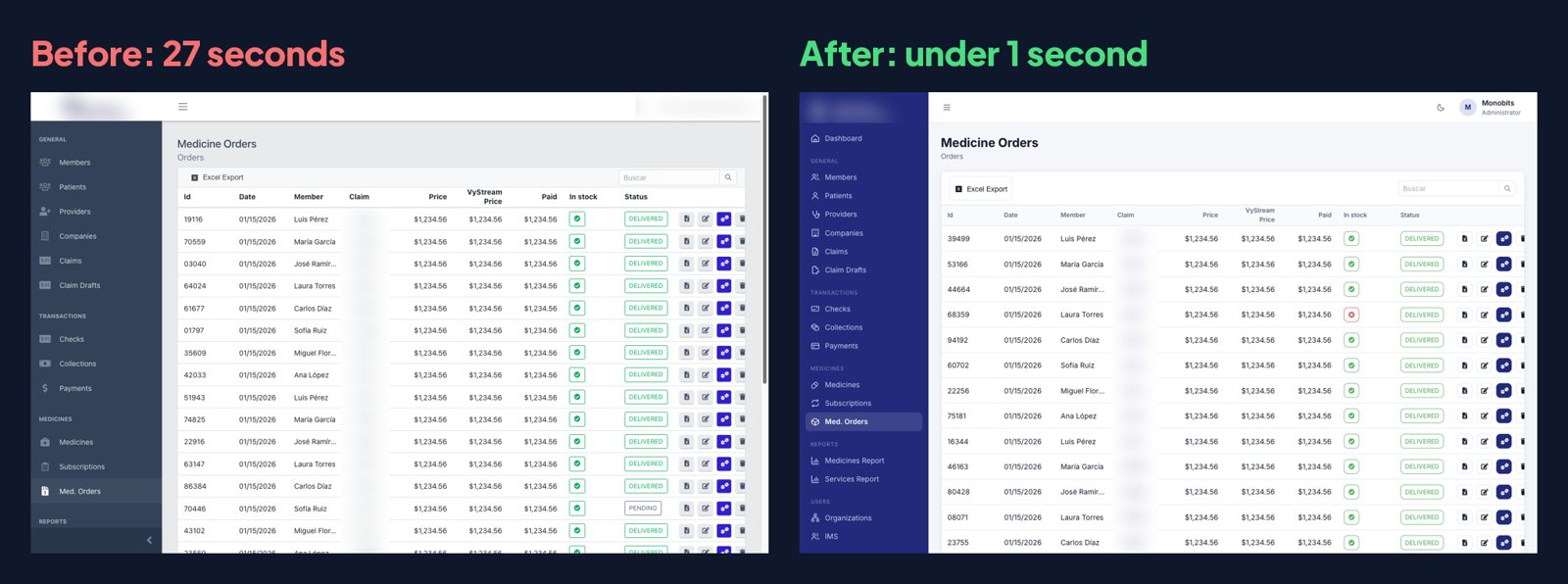
One of my favorite cases is a company that handles US medical insurance claims for patients treated in Mexico. Their team lives inside the system all day: entering claims, medical orders and checks.
The system had screens so old that some took up to 40 seconds to load, and reports that took 6 or 7 minutes to come out. Imagine your team waiting for that several times a day.
We measured before and after: the medical orders screen went from 27 seconds to under one, and today every main screen opens in about a second. Reports come out in under 10 seconds, depending on the filters you use. It also looks completely different, but the team works exactly the same way: same steps, same places. The manager is very happy with the change, and the switch itself was done in one night, without their operation stopping.
"I'd rather leave it alone while it works"
I get it. Sometimes there's no budget, and sometimes it simply isn't the right time. That's why we don't propose everything at once. We organize the work like a traffic light:
- Red: what's urgent, usually for security: yours and your clients'.
- Yellow: what can wait a little, but not much.
- Green: the final stage of the modernization.
To many clients I say: let's do red and yellow first, and we'll handle the rest later.
And if even red isn't possible? Then I encapsulate the system: I isolate it and leave it as secure as possible, without making big changes, so that if someone ever finds a door, they can't get past it. It's part of our protocol, and I also do it to protect the rest of the clients who trust us.
But encapsulating is a patch to buy time, not a solution. A system that works today isn't the same as a secure system, and you notice the difference on the day it's already too late.
Is your system getting old?
If your system has been around for a while and you don't know what color it is on the traffic light, write to us. We'll review it and tell you what's urgent, what can wait, and how the switch would be done without stopping your business.